

When it comes to the bench press, foot positioning can make a significant difference in your performance, stability, and overall comfort. Two popular approaches are the tripod foot position, where your whole foot is planted firmly on the ground, and the ball-of-the-foot position, where your heels are lifted, and your toes and forefoot create the base.
Neither position is inherently wrong. If you’re not competing in a powerlifting federation with strict rules about specific foot placement, the best choice is the one that feels most comfortable and allows you to perform optimally. Let’s explore the differences, benefits, and considerations for each style to help you make the right choice for your training.

1. The Tripod Foot Position
The tripod position involves planting your entire foot firmly on the ground, with equal pressure distributed across three points: the heel, the ball of the foot, and the big toe. This creates a stable, rooted base and promotes a solid connection to the floor.
Benefits of the Tripod Position:
• Enhanced Stability: By grounding your entire foot, you create a stable foundation that allows for better overall control during the lift. This stability is particularly beneficial when pressing heavier weights.
• Improved Force Transfer: A fully planted foot enables efficient leg drive, as the energy generated by your lower body can transfer through your torso to the barbell.
• Natural Lower Body Engagement: The tripod position encourages full lower-body involvement without requiring excessive mobility in the hips or ankles.
Who Might Prefer This?
The tripod position is ideal for lifters who prioritize stability and control, especially beginners or those working on perfecting their technique. It’s also a great choice for those with limited hip or ankle mobility, as it requires less flexibility than other foot positions.
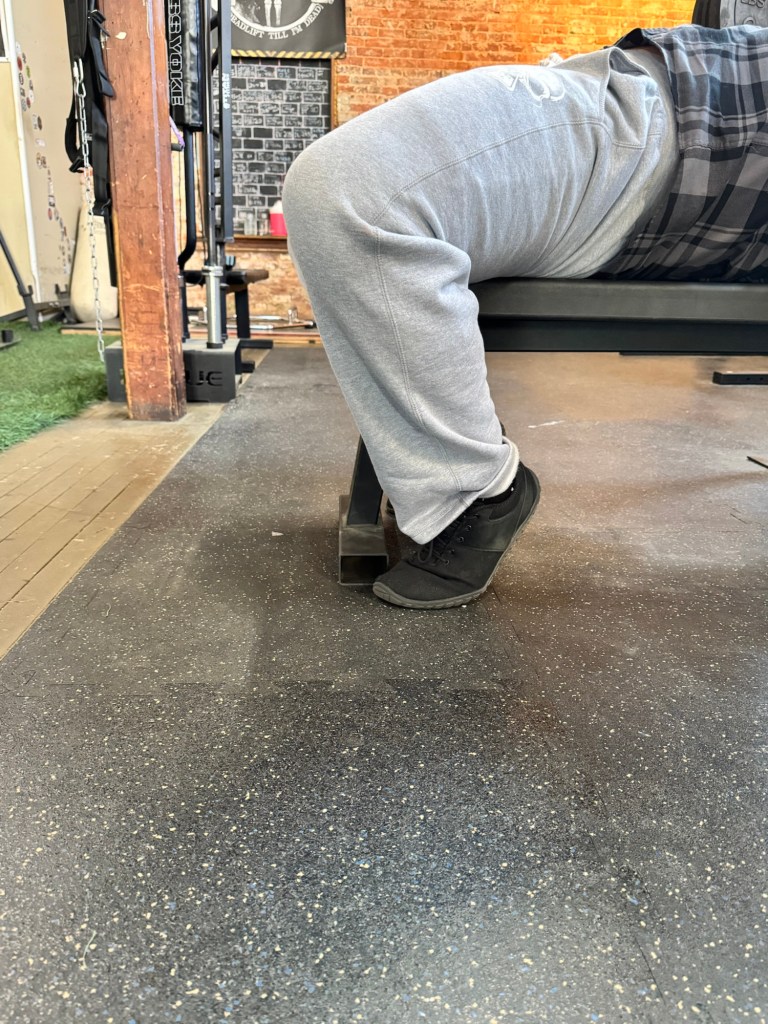
2. The Ball-of-the-Foot Position
In this setup, your heels are lifted, and the weight is concentrated on the balls of your feet and toes. This often involves tucking your feet further back toward the bench, creating a more compact and aggressive position.
Benefits of the Ball-of-the-Foot Position:
• Increased Power Potential: For some lifters, tucking the feet and pressing through the balls of the feet allows for a stronger, more explosive leg drive.
• Compact Setup: The ball-of-the-foot position can help lifters achieve a bigger arch in the lower back, reducing the range of motion and potentially improving pressing performance.
• Dynamic Energy Transfer: While slightly less stable than the tripod position, the ball-of-the-foot position allows for quick adjustments and explosive force application.
Who Might Prefer This?
This position is often favored by more advanced lifters who have developed strong body awareness and mobility. It’s also a common choice for those looking to maximize their arch and minimize the distance the bar needs to travel.
Key Similarities: Maximizing Tension and Leg Drive
No matter which foot position you choose, the ultimate goal is to create full-body tension and utilize leg drive effectively. Leg drive is a crucial component of the bench press, as it helps stabilize your upper body and transfer force to the barbell.
Here’s how to maximize tension regardless of your foot placement:
1. Root Your Feet: Whether your whole foot or just the balls of your feet are on the ground, actively press into the floor to create a strong base.
2. Engage the Lower Body: Squeeze your glutes and engage your quads to maintain tension throughout the lift.
3. Maintain Core Stability: Keep your core tight to prevent energy leaks and ensure your torso remains stable as you press.
4. Synchronize Your Leg Drive: Use your leg drive to assist the lift as you press the bar off your chest, ensuring your lower and upper body work together.
Choosing the Right Position for You
The decision between the tripod position and the ball-of-the-foot position ultimately comes down to individual preference and biomechanics.
• If you value stability and feel stronger with your feet flat on the ground, the tripod position is likely your best bet.
• If you feel more powerful with your feet tucked back and want to create a larger arch, pressing through the balls of your feet may suit you better.
Experiment with both styles to determine which feels more comfortable and allows you to perform your best. Keep in mind that your preferred position may evolve as you gain experience, mobility, and strength.
Final Thoughts
Foot placement in the bench press is more than a small detail—it can significantly impact your stability, power, and overall performance. Neither the tripod nor ball-of-the-foot position is universally better; it’s about finding the setup that works best for your body and training goals.
Whichever position you choose, remember to focus on maximizing tension, maintaining stability, and using leg drive effectively. The bench press is a full-body lift, and your foot position is a key component of a successful rep. With a little experimentation and attention to detail, you’ll find the foot placement that helps you press stronger, safer, and more confidently.
Stay Strong,
Coach Frank
 Sports Performance and Private Training