Skip to content
  • Sports Performance and Private Training
  • Coach Bios
  • Blog
  • Contact
  • Shop
  • Sports Performance and Private Training
  • Coach Bios
  • Blog
  • Contact
  • Shop

CONTACT

3765 Old Philadelphia Pike
Bethlehem PA 18015
(717) 440-1856
Monday - Friday 6 a.m. - 8 p.m.
Saturday 6 a.m. - noon

FOLLOW

  • Facebook
  • Twitter
  • Instagram

GALLERY

DarrunHilliard
MattMowad
JWestAcceleration
GatesSled
TrapsSquat
JWestCOD1
Yolk
TrapsPretzelJPG
Deadlift
DudeckPlatePush
IMG_9767
GabeKarslo2
DarrunHilliardUnderwater
FilippoSquat
Flem
NickBeinlich
GabeKarslo
SpencerGross3
LVU2
  • strength training
  • health
  • Personal Growth
  • Uncategorized
  • Sports Performance and Private Training
  • Coach Bios
  • Blog
  • Contact
  • Shop
Sports Performance and Private Training

Sports Performance and Private Training

  • Sports Performance and Private Training
  • Coach Bios
  • Blog
  • Contact
  • Shop
  • strength training

Squat Mechanics: Why Your Body’s Biomechanics Shape Your Squat

Frank Donley Training's avatar Frank Donley Training January 22, 2025

When it comes to squats, one thing is clear: no two squats look the same, nor should they. Biomechanics—specifically the lengths of your femurs, torso, and other body segments—play a significant role in how your squat looks and feels. To perform a high-quality squat, the key is keeping the barbell balanced over the midfoot throughout the movement. However, achieving that balance will look different for everyone, depending on their unique body structure.

Instead of forcing everyone to fit into a cookie-cutter squat with generic cues, let’s take an individualized approach to help you develop the best squat for YOUR body.

The Role of Biomechanics in Squat Mechanics

Long Femurs

If you have long femurs relative to your torso, you’ll naturally find squats more challenging, particularly when it comes to maintaining an upright torso. Your femurs will push your hips further back, creating a greater forward lean to keep the barbell balanced over your midfoot.

For long-femured lifters:

• Optimal Squat Style: Low-bar back squats tend to feel more natural, as they allow for a more forward torso lean and reduce strain on your lower back.

• Stance Tips: A slightly wider stance with feet turned out can help you open your hips and reduce the forward lean.

• Mobility Work: Focus on hip and ankle mobility to maintain depth without rounding your lower back.

Short Femurs

Short femurs make squatting look effortless. Lifters with this proportion can maintain a more upright torso, even in a deep squat, as their hips don’t need to travel as far back.

For short-femured lifters:

• Optimal Squat Style: High-bar back squats or front squats work well, as the upright position feels more natural.

• Stance Tips: A shoulder-width stance often works best, but adjust based on comfort and hip mobility.

• Strength Focus: Prioritize quads and core strength to maximize performance and stability in this position.

Long Torso

A long torso allows for a more upright squat position, as the center of gravity stays closer to the midfoot. However, this proportion can place more stress on the lower back if not managed properly.

For long-torso lifters:

• Optimal Squat Style: High-bar back squats or front squats are ideal, as they complement the upright position.

• Stance Tips: Experiment with stance width, as mobility and comfort will determine the best positioning.

• Mobility Work: Strengthen your posterior chain and work on thoracic spine mobility to maintain a strong, neutral position under heavy loads.

Short Torso

Lifters with short torsos often find it challenging to remain upright, particularly if paired with long femurs. They’ll naturally lean forward more during squats, which increases the demand on the posterior chain.

For short-torso lifters:

• Optimal Squat Style: Low-bar to mid-bar back squats are usually better suited, as they reduce the need for an upright position.

• Stance Tips: A slightly wider stance and turned-out toes can help maintain balance and depth.

• Strength Focus: Build strong glutes, hamstrings, and spinal erectors to support the forward lean.

The Key: Individualized Squats

The biggest mistake in teaching squats is relying on overused, generalized cues like “chest up” or “stay upright,” without considering individual biomechanics. A “perfect” squat for one person could look completely different for someone else.

Here’s how to develop the best squat for YOU:

1. Film Yourself: Record your squats from multiple angles to identify your natural movement patterns.

2. Experiment: Try different squat styles (high-bar, low-bar, front squats) to see what feels best.

3. Adjust Your Stance: Play with your foot placement and toe angle to find the most stable and comfortable position.

4. Focus on Mobility: Address any mobility restrictions, especially in the hips, ankles, and thoracic spine, to improve depth and alignment.

5. Seek Professional Guidance: Work with a coach who understands biomechanics and can help tailor your squat to your body’s proportions.

Stop Forcing Square Pegs Into Round Holes

Squats are not one-size-fits-all. Forcing every lifter into a standardized technique ignores the unique biomechanics that dictate how they move. Instead of trying to fit a square peg into a round hole, take an individualized approach. Focus on keeping the barbell balanced over the midfoot and adjust your squat mechanics to suit your body.

Embrace your biomechanics, train with intention, and unlock your full squatting potential. Your best squat isn’t about mimicking someone else—it’s about maximizing YOUR strength, mobility, and balance.

  • health
  • Personal Growth
  • strength training

Key Areas for Beginner Trainees to Focus on for Long-Term Success

Frank Donley Training's avatar Frank Donley Training January 17, 2025

By Cory Woolf

Starting your fitness journey can feel overwhelming with so much information out there. It’s easy to get caught up in the latest trends, fitness challenges, or the pressure to see fast results. However, as a beginner, focusing on a few foundational habits will set you up for lasting success. Rather than chasing quick fixes or complicated routines, concentrate on two to three core areas that can make a real difference: consistency in strength training, walking daily, and prioritizing sleep. Let’s dive into each one.

Consistency in Strength Training

When you’re new to strength training, the key is consistency—not intensity. Strength training is a cornerstone of any well-rounded fitness program because it builds muscle, boosts metabolism, enhances overall strength, and improves mood. As a beginner, it’s important to start slowly and gradually build up.

Two to three days a week is a great start, as it gives your body enough stimulus to adapt without overwhelming it. This is the groundwork for future progress. Many beginners get excited and try to train every day right out of the gate, but this can often lead to exhaustion or injury. A few days a week allows for proper recovery, which is essential for beginners. Going to the gym consistently—even if only for 30–45 minutes—will yield far better results than sporadic, intense sessions. The goal should be to make strength training a regular part of your routine.

As a beginner, it’s helpful to focus on compound exercises (like squats, hinging, pressing, and pulling) that target multiple muscle groups. These movements build functional strength and create a solid base for more advanced exercises later. However, before adding a bunch of weight, mastering proper technique is critical. Focus on performing exercises correctly to avoid injury and develop good movement patterns that will serve you well in the future.

Daily Walks

While strength training is essential, don’t underestimate the benefits of walking. Walking is an incredibly simple and effective way to increase daily physical activity, boost your overall fitness, and improve your health. Here’s why:

• Promotes recovery: Walking helps stimulate blood flow, which aids in muscle recovery and reduces soreness from strength training.

• Increases overall movement: If you’re working in a sedentary job or lifestyle, walking is a low-impact way to stay active without taxing your body.

• Supports weight management: Regular walking helps with calorie burning and fat loss in a sustainable way. Albeit not a lot of calories, but every step counts.

• Improves mood and reduces stress: Walking outdoors, especially in nature, can reduce anxiety and enhance your mental health.

You don’t need to aim for long, intense walks—10-20 minutes of brisk walking daily is enough to get the benefits. Consider walking after meals or as part of your routine to build it into your day.

Consistent Sleep Schedule

Sleep is arguably the most underrated aspect of fitness. While strength training breaks down muscle tissue, it’s during rest that your body repairs and builds the muscles back up. If you’re not prioritizing sleep, you’re hindering your ability to recover and perform at your best.

During deep sleep, your body releases growth hormone, which aids in muscle recovery and repair. Without proper sleep, muscle growth will be compromised. Sleep also plays a crucial role in energy levels. When well-rested, you’ll have the stamina to push harder during your workouts and stay consistent in your routine. Lastly, a consistent sleep schedule helps with mental clarity, focus, and stress management—essential elements for staying committed to your fitness journey.

How to Improve Your Sleep:

• Set a consistent bedtime and wake time: This helps regulate your internal clock. While this may not be feasible every day, aiming for 7-8 hours of sleep is key.

• Avoid screens before bed: The blue light emitted from phones, tablets, and computers can interfere with melatonin production, making it harder to fall asleep.

• Create a calming bedtime routine: Reading, stretching, or practicing mindfulness can signal to your body that it’s time to wind down.

As a beginner, the most important thing is consistency. Consistently hitting the gym 2-3 days a week, walking daily and getting adequate sleep will create a solid foundation for long-term progress. Once you’ve nailed down these habits, the next step is to focus on eating a balanced diet—primarily whole foods rich in protein and fiber. But remember, take it one step at a time. It’s not about perfection; it’s about making small, sustainable changes that will lead to big results over time. Fitness is a marathon, not a sprint. By focusing on consistency and gradual progress, you’ll set yourself up for success in the long run. 

“Success is the sum of small efforts, repeated day in and day out.” – Robert Collier

  • health
  • strength training

Foot Position in the Bench Press: Tripod vs. Ball of the Foot

Frank Donley Training's avatar Frank Donley Training January 14, 2025

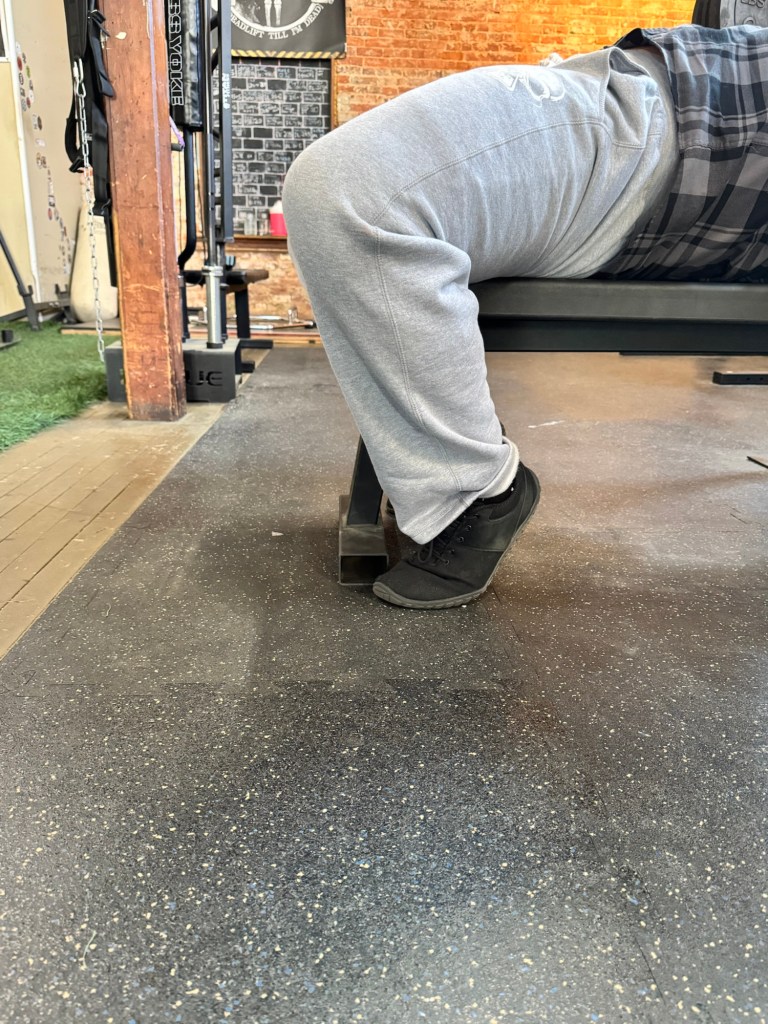
When it comes to the bench press, foot positioning can make a significant difference in your performance, stability, and overall comfort. Two popular approaches are the tripod foot position, where your whole foot is planted firmly on the ground, and the ball-of-the-foot position, where your heels are lifted, and your toes and forefoot create the base.

Neither position is inherently wrong. If you’re not competing in a powerlifting federation with strict rules about specific foot placement, the best choice is the one that feels most comfortable and allows you to perform optimally. Let’s explore the differences, benefits, and considerations for each style to help you make the right choice for your training.

1. The Tripod Foot Position

The tripod position involves planting your entire foot firmly on the ground, with equal pressure distributed across three points: the heel, the ball of the foot, and the big toe. This creates a stable, rooted base and promotes a solid connection to the floor.

Benefits of the Tripod Position:

• Enhanced Stability: By grounding your entire foot, you create a stable foundation that allows for better overall control during the lift. This stability is particularly beneficial when pressing heavier weights.

• Improved Force Transfer: A fully planted foot enables efficient leg drive, as the energy generated by your lower body can transfer through your torso to the barbell.

• Natural Lower Body Engagement: The tripod position encourages full lower-body involvement without requiring excessive mobility in the hips or ankles.

Who Might Prefer This?

The tripod position is ideal for lifters who prioritize stability and control, especially beginners or those working on perfecting their technique. It’s also a great choice for those with limited hip or ankle mobility, as it requires less flexibility than other foot positions.

2. The Ball-of-the-Foot Position

In this setup, your heels are lifted, and the weight is concentrated on the balls of your feet and toes. This often involves tucking your feet further back toward the bench, creating a more compact and aggressive position.

Benefits of the Ball-of-the-Foot Position:

• Increased Power Potential: For some lifters, tucking the feet and pressing through the balls of the feet allows for a stronger, more explosive leg drive.

• Compact Setup: The ball-of-the-foot position can help lifters achieve a bigger arch in the lower back, reducing the range of motion and potentially improving pressing performance.

• Dynamic Energy Transfer: While slightly less stable than the tripod position, the ball-of-the-foot position allows for quick adjustments and explosive force application.

Who Might Prefer This?

This position is often favored by more advanced lifters who have developed strong body awareness and mobility. It’s also a common choice for those looking to maximize their arch and minimize the distance the bar needs to travel.

Key Similarities: Maximizing Tension and Leg Drive

No matter which foot position you choose, the ultimate goal is to create full-body tension and utilize leg drive effectively. Leg drive is a crucial component of the bench press, as it helps stabilize your upper body and transfer force to the barbell.

Here’s how to maximize tension regardless of your foot placement:

1. Root Your Feet: Whether your whole foot or just the balls of your feet are on the ground, actively press into the floor to create a strong base.

2. Engage the Lower Body: Squeeze your glutes and engage your quads to maintain tension throughout the lift.

3. Maintain Core Stability: Keep your core tight to prevent energy leaks and ensure your torso remains stable as you press.

4. Synchronize Your Leg Drive: Use your leg drive to assist the lift as you press the bar off your chest, ensuring your lower and upper body work together.

Choosing the Right Position for You

The decision between the tripod position and the ball-of-the-foot position ultimately comes down to individual preference and biomechanics.

• If you value stability and feel stronger with your feet flat on the ground, the tripod position is likely your best bet.

• If you feel more powerful with your feet tucked back and want to create a larger arch, pressing through the balls of your feet may suit you better.

Experiment with both styles to determine which feels more comfortable and allows you to perform your best. Keep in mind that your preferred position may evolve as you gain experience, mobility, and strength.

Final Thoughts

Foot placement in the bench press is more than a small detail—it can significantly impact your stability, power, and overall performance. Neither the tripod nor ball-of-the-foot position is universally better; it’s about finding the setup that works best for your body and training goals.

Whichever position you choose, remember to focus on maximizing tension, maintaining stability, and using leg drive effectively. The bench press is a full-body lift, and your foot position is a key component of a successful rep. With a little experimentation and attention to detail, you’ll find the foot placement that helps you press stronger, safer, and more confidently.

Stay Strong,

Coach Frank

  • health
  • Personal Growth
  • strength training

How to Set and Achieve Your Goals in 2025: A SMART Approach

Frank Donley Training's avatar Frank Donley Training January 6, 2025

By Cory Woolf

As we step into 2025, setting meaningful goals is the first step towards making this year your best one yet. Whether you’re aiming for personal growth, career advancement, or healthier habits, goal setting is a powerful tool to turn your aspirations into reality. One of the most effective ways to set yourself up for success is by using the SMART method—an approach designed to keep you focused, motivated, and on track.

The SMART Method

S – Specific

Your goal needs to be clear and well-defined. Instead of vague objectives like, “I want to get fit” or “I want to get healthier,” get specific about how you’ll achieve it. For example: “I will exercise 3 days a week for 30 minutes.” If you’re training for something specific, such as a marathon or strength goals, clarify the type of exercise you’ll focus on—whether it’s weightlifting, running, swimming, etc.

M – Measurable 

It’s important to be able to track your progress. This keeps you accountable and motivated as you move toward your goal. For instance, with the exercise goal, you can log how often you exercise each week and track your session durations. This allows you to see progress and adjust if necessary. 

A – Achievable 

Your goal must be realistic based on your resources, time and limitations. The key here is to aim for progress, not perfection. If you’re new to exercise, setting a goal to work out 6 days a week might feel overwhelming. But committing to just 2 days a week and sticking with it long-term is more manageable and will still deliver great results. 

R – Relevant

Your goal should truly matter to you and align with your greater life ambitions. This is the “why” behind your goal. If long-term health is your vision, committing to regular exercise is highly relevant and worthwhile. When your goal is connected to your values, it becomes easier to stay motivated.

T – Time-Bound

Set a deadline to create urgency and prevent procrastination. Without a timeline, it’s easy to let your goal slip down the priority list. For example, “I will exercise 3 days a week for 30 minutes over the next 3 months.” A clear time frame helps you measure progress and stay on track.

Additional Tips for Success

Once you’ve established your SMART goal, here are a few more strategies to help you stay on course: 

1. Make Your Goals Visible 

This might sound simple, but it’s incredibly effective. Place reminders of your goal in places you frequent—your desk, mirror, fridge, or even on your phone screen. These visual cues act as constant prompts, keeping your goal at the forefront of your mind and boosting motivation to take action.

2. Use Positive Self-Talk 

The language you use with yourself plays a huge role in your success. Avoid negative or self-sabotaging thoughts. Instead, focus on affirming your ability to achieve your goal. For instance, replace “I can’t do this” with “I’m capable of making progress every day.” Positive self-talk can keep your mindset in a growth-oriented place, helping you overcome obstacles with confidence, 

3. Focus on One Goal at a Time

While it’s tempting to set multiple goals at once, focusing on one goal increases the likelihood of success. Trying to overhaul your entire life at once can lead to burnout. Master one habit first, and once it’s ingrained in your routine, move on to the next. This focused approach not only makes your goals more attainable, but it also builds momentum that propels you towards success.

4. Establish Habits That Suit Your Vision

Small, consistent habits are the building blocks of long-term success. Identify simple daily actions that move you closer to your goal and align with your overall vision. Whether it’s setting aside time for exercise, meal prepping or practicing mindfulness, the key is consistency. Over time, these habits will become second nature, and the results will speak for themselves. 

By using the SMART method to clearly define your goals, making them visible, staying positive, focusing on one goal and building habits that align with your vision, 2025 can be the year you truly achieve what you set out to do. 

Happy New Year—and happy goal setting!

  • health
  • Personal Growth
  • strength training

The Best Day to Start Was Yesterday. The Next Best Day is Today. Why You Shouldn’t Wait to Begin Your Gym Journey

Frank Donley Training's avatar Frank Donley Training December 27, 2024

When it comes to hitting the gym, the idea of starting tomorrow is one of the most common mental traps people fall into. We tell ourselves we’ll begin when we feel ready, have more time, or after the next big event in our lives. The truth is, life rarely clears a perfect path for us to start something new—especially something as transformative and challenging as a health journey.

The best day to start was yesterday, but the next best day is today. Here’s why you shouldn’t wait another moment to begin working out.

Procrastination Steals Your Progress

Every day you put off starting is another day you miss the opportunity to improve your health, strength, and confidence. It’s easy to think that a few days, weeks, or even months won’t matter in the grand scheme of things, but time adds up quickly. A year from now, you could look back and wish you’d started today.

Imagine the progress you could make in just three months of consistent training. Whether it’s losing weight, building muscle, improving your endurance, or simply feeling more energetic, those results are waiting for you. But they require action now.

There’s No Such Thing as “The Perfect Time”

One of the biggest misconceptions about fitness is that you need the perfect conditions to begin. People think they need to:

• Wait until their schedule clears up.

• Get in better shape before joining a gym.

• Find the ideal workout plan.

The reality? There will never be a perfect time to start. Life is messy and unpredictable, and waiting for the stars to align is just another form of procrastination. Starting today—even if it’s with small, imperfect steps—builds momentum. Momentum is what carries you forward when motivation wavers.

Your Future Self Will Thank You

Think about the version of yourself you want to be a year from now. Do you want to look in the mirror and see someone who took action despite the excuses? Or someone who is still stuck in the same cycle of “I’ll start tomorrow”?

Starting today is a gift to your future self. It’s the moment you say, “I’m worth the effort.” Every workout, healthy meal, and moment of self-discipline adds up to create the best version of you.

It’s Not Just About Physical Gains

While the physical benefits of going to the gym are undeniable, the mental and emotional gains are equally transformative. Movement is a proven stress reliever, mood booster, and confidence builder. It teaches resilience, discipline, and the power of consistency—skills that translate to every area of life.

The sooner you begin, the sooner you’ll feel these benefits. Even just one workout can lift your mood and remind you of your potential. Over time, the gym becomes more than a place to work out; it becomes a sanctuary where you prove to yourself what you’re capable of.

Small Steps Lead to Big Wins

You don’t need to overhaul your entire life to start your gym journey. Start small. Commit to 30 minutes a day. Walk into the gym and get familiar with the space. If you are new, seek guidance with a qualified trainer that prioritizes your goals!

The hardest part is getting started, but once you do, you’ll realize that every small step builds confidence. Over time, these small steps snowball into massive progress.

Take Action Today

The decision to start your gym journey is not about waiting for the perfect moment or feeling completely ready. It’s about recognizing that your health and well-being deserve attention right now. The longer you wait, the harder it becomes to break the cycle of inactivity.

So take that first step today. Sign up for a gym membership, schedule your first workout, or even just set your alarm 30 minutes earlier tomorrow. Starting doesn’t have to be perfect; it just has to happen.

Remember: The best day to start was yesterday. The next best day is today.

Your future self is cheering for you. Make them proud.

Stay STRONG,

Coach Frank

  • health
  • Personal Growth
  • strength training

Women and Strength Training: Why you should be strength training?

Frank Donley Training's avatar Frank Donley Training December 9, 2024

By Coach Cory Woolf

Women and strength training is always a tricky topic to navigate. Strength training has long been dominated by stereotypes and misconceptions that often deter women from lifting weights. However, the body does not discriminate, and the benefits of strength training apply equally to both men and women. Overcoming these barriers is crucial for women’s long-term health and well-being.

Barriers to Strength Training

1. Fear of Becoming Bulky or Too Muscular: This is one of the most common misconceptions in strength training. Let’s make this clear, nature did not design women to look and grow the way as men do. Women have lower levels of testosterone (~15-20% lower concentrations), which makes it awfully hard for them to develop large muscles like men. Testosterone plays a key part in muscle protein synthesis and men tend to consume more protein in general, therefore allowing greater size in muscle mass. Fortunately, women produce more estrogen, which plays a key role in recovery for them.

2. Intimidation: Walking into a gym dominated by men can be scary thing for anyone, especially for women who may feel out of place or judged. Not much more needed here.

3. Lack of Knowledge: Many women are unsure how to start a strength training program, what exercises to do, how many reps, sets, etc., which can also make it difficult to start.

4. Social Stigma: There’s still a belief that women should focus solely on cardio or “light” exercises, rather than lifting heavy weights. Though, cardio training has its benefits, strength training is just as important if not, of more importance. 

Other common barriers include, lack of motivation, fear of getting hurt, and having no time. No body is motivated all the time. Strength training can reduce the risk of injury when done properly. Lastly, everyone has time. You’re just not prioritizing strength training or working out. 


Why Women Should Strength Train


1. Improved Overall Health: Strength training offers several health benefits including an increase in bone mineral density, improved metabolism, better cardiovascular health, improved sleep quality and a reduced risk of injury just to name a few. 

2. Body Composition: Unlike cardio exercises alone, strength training helps build lean muscle mass, which can lead to a toned and strong physique.

3. Boosted Confidence: Mastering new exercises and seeing progress in strength and body composition can boost self-confidence and empowerment.

4. Functional Strength: As you become stronger, everyday tasks start to become easier, such as, carrying bags of groceries in the house, doing yard work or keeping up with children. How about that cranky jar of pickles you can’t seem to open? Screw getting your husband when you can open it on your own. 

5. Long-Term Wellness: As we all age, maintaining muscle mass becomes increasingly important for preventing age-related health issues like osteoporosis (decrease in mineral and bone density) and sarcopenia (muscle and strength loss as you age). Not to mention many studies show that regular exercise can help reduce the risk of cognitive impairment and dementia compared to those who don’t.

Overcoming Barriers

​To break down these barriers, women can take several steps:

• Education: Educate yourself on the benefits of strength training and how it can enhance your overall health and wellness. 

• Start Small: Begin with bodyweight exercises or light weights to build a nice foundation of strength and build confidence in the weight room. As you get stronger and more confident, you can progress to harder exercises and heavier weights.

• Seek Support: Consider working with a personal trainer who understands your goals and can create a personalized strength training program for you. A trainer can teach you proper form on exercises and progress them as you become more comfortable and confident. 

• Find a Comfortable Environment: Find a gym or workout space where you feel comfortable and supported. There are plenty of gyms that have a welcoming community and a strong support system for you to grow in and get the help you need. 


Strength training is not just about lifting the weights; it’s about breaking down barriers and empowering women to take control of their health and fitness. Strength training is not a quick fix or overnight success, it’s a lifestyle and takes discipline and dedication to achieve the body and mindset you want to strive for. Start your fitness journey today and see improvements in all aspects of life.

  • health
  • Personal Growth
  • strength training

The Harsh Reality of Getting Strong

Frank Donley Training's avatar Frank Donley Training December 3, 2024

If it was easy, everyone would be doing it. But the truth is, getting strong takes time, effort, and perseverance. We’ve all been there – we start a new workout routine, full of enthusiasm and motivation, only to hit a plateau or encounter a setback.

But here’s the thing: getting strong isn’t just about physical transformation. It’s about mental toughness, discipline, and resilience. It’s about showing up every day, even when you don’t feel like it, and putting in the work.

Overcoming Obstacles and Staying Disciplined

So, how do you overcome the obstacles and stay disciplined on your health journey? Here are a few key takeaways:

• Expect setbacks and plateaus. They’re a natural part of the journey.

• Stay disciplined and consistent. Show up every day and put in the work.

• Focus on progress, not perfection. Celebrate small wins and don’t be too hard on yourself when you slip up.

• Find a community or accountability partner. Having someone to support and motivate you can make all the difference.

Remember, getting strong isn’t easy. But with the right mindset and support, you can overcome any obstacle and achieve your strength and health goals. Stay disciplined, stay consistent, and most importantly, stay committed to your journey.

Sincerely,

Coach Frank

  • health
  • strength training

The Pull-Up Journey: A Step-by-Step Guide to Achieving Your First Pull-Up

Frank Donley Training's avatar Frank Donley Training November 20, 2024

Are you ready to take your STRENGTH journey to new heights? Achieving your first pull-up is a milestone worth celebrating, and with consistent practice and dedication, you can get there! In this article, we’ll break down the steps to help you achieve your first pull-up.

The Journey Begins

Step 1: Hang in There!

Spend more time on the bar, getting comfortable with your own weight. Hanging from the bar helps build grip strength, shoulder stability, and overall endurance.

Step 2: Groove the Scapular Retraction Drill

Retract and depress those shoulder blades, packing your shoulders for lift-off! This drill helps solidify proper shoulder positioning and engagement.

Step 3: Master the Negatives

Start at the top, slowly lower down, and own that deadhang! Negatives help build strength and control.

Grease the Groove

Prioritize pull-ups early in your workout and hit them frequently throughout the week. Consistency is key!

Benefits of Pull-Ups

Increased Strength

Pull-ups target multiple muscle groups, including lats, shoulders, and arms.

Improved Posture

Pull-ups help maintain proper spinal alignment and shoulder positioning.

Enhanced Athleticism

Pull-ups improve overall athleticism, boosting performance in various sports.

Tips for Success

Start Slow

Begin with shorter hangs and gradually increase time.

Focus on Form

Maintain proper posture and engagement throughout.

Achieving your first pull-up requires patience, persistence, and practice. Stay committed, and you’ll be pulling up in no time!

Join the Journey

Share your pull-up progress and connect with fellow STRENGTH enthusiasts!

Find more STRENGTH tips at ⬇️

Instagram @frankdonleytraining

  • health
  • Personal Growth
  • strength training

Embracing the 80/20 Lifestyle: A Sustainable Path to Wellness for the Majority

Frank Donley Training's avatar Frank Donley Training November 14, 2024

In the season of soon to be New Year’s resolutions, achieving optimal health and strength can seem daunting. With the constant bombardment of unrealistic fitness goals and quick fixes, it’s easy to get caught up in the idea that only extreme dedication yields results. However, for the majority of people, this approach is not only unsustainable but also unnecessary. Enter the 80/20 lifestyle, a balanced approach to wellness that prioritizes consistency and sustainability over perfection.

The Pitfalls of Perfectionism

Professional athletes and bodybuilders require rigorous training and nutrition plans, but for the average person, this level of commitment is unrealistic. Attempting to follow such a regimen can lead to burnout, frustration, and ultimately, abandonment of healthy habits altogether. The 80/20 lifestyle recognizes that it’s unnecessary to be perfect; instead, focusing on making sustainable choices 80% of the time allows for flexibility and enjoyment.

Benefits of the 80/20 Lifestyle

Consistency

By aiming for 80% adherence to a strength and nutrition plan, individuals prioritize consistency over perfection. This approach allows for:

  • Long-term progress: Steady, incremental changes yield more significant results than sporadic bursts of intense effort.
  • Increased motivation: Celebrating small victories fosters a sense of accomplishment and encourages continued progress.

Sustainability

The 80/20 lifestyle acknowledges that life is unpredictable, and setbacks are inevitable. By building flexibility into your plan, you:

  • Avoid guilt and shame: Allowing for indulgences and setbacks reduces feelings of failure, promoting a healthier relationship with food and exercise.
  • Foster resilience: Learning to adapt to challenges ensures continued progress despite obstacles.

Nutrition

Applying the 80/20 principle to nutrition means:

  • Balanced eating: Focusing on whole foods, with room for indulgences, ensures essential nutrients are met.
  • Reduced stress: Eliminating the need for rigid adherence to a diet plan reduces anxiety and promotes enjoyment.

Strength Training

Incorporating strength training into your 80/20 lifestyle:

  • Improves overall health: Regular movement enhances cardiovascular health, increases strength and boosts mental well-being.
  • Enhances sustainability: Gradual progress and achievable goals maintain motivation.

Implementation

To incorporate the 80/20 lifestyle into your daily routine:

  1. Set realistic goals: Aim for 80% adherence to your strength and nutrition plan.
  2. Prioritize consistency: Focus on making sustainable choices.
  3. Embrace flexibility: Allow for indulgences and setbacks.
  4. Celebrate progress: Acknowledge small victories.

The 80/20 lifestyle offers a refreshing alternative to the all-or-nothing approach. By embracing consistency, sustainability and flexibility, individuals can achieve optimal health and wellness without sacrificing enjoyment. Ditch the pressure to be perfect and adopt the 80/20 lifestyle – your body and mind will thank you.

  • health
  • Personal Growth
  • strength training

Strength: The Foundation for a Great Life

Frank Donley Training's avatar Frank Donley Training November 1, 2024

We often find ourselves chasing success, happiness, and fulfillment. However, in our pursuit of these goals, we may overlook the most essential element that underpins them all: strength. Strength is more than just physical power; it encompasses emotional resilience, mental toughness, and spiritual fortitude. In this blog, we’ll explore why strength is the foundation for a great life.

Physical Strength

Physical strength is the most apparent form of strength, and for good reason. Our bodies are capable of incredible feats when we prioritize strength training, sleep, and nutrition. Physical strength:

· Boosts confidence and self-esteem
· Enhances mental clarity and focus
· Improves overall health and well-being
· Increases resilience to disease and injury

Emotional Strength

Emotional strength is just as vital as physical strength. It enables us to:

· Develop healthy relationships and boundaries
· Manage stress and anxiety
· Cultivate empathy and compassion
· Build resilience in the face of adversity

Mental Strength

Mental strength is the backbone of our decision-making and problem-solving abilities. It allows us to:

· Stay focused and motivated
· Overcome obstacles and setbacks
· Develop a growth mindset
· Make informed, thoughtful choices

Spiritual Strength

Spiritual strength connects us to our values, purpose, and something greater than ourselves. It:

· Provides guidance and direction
· Fosters gratitude and appreciation
· Cultivates mindfulness and presence
· Inspires personal growth and transformation

Why Strength Matters

So, why is strength the foundation for a great life? Here are a few compelling reasons:

· Strength enables us to overcome obstacles and achieve our goals.
· Strength builds resilience, allowing us to bounce back from setbacks.
· Strength fosters confidence, empowering us to take risks and pursue our passions.
· Strength inspires personal growth, leading to a more fulfilling and purpose-driven life.

Strength is the bedrock upon which a great life is built. By cultivating physical, emotional, mental, and spiritual strength, we lay the groundwork for a life marked by resilience, confidence, and purpose. So, prioritize strength training, nurture your emotional well-being, challenge your mind, and connect with your spirit. With strength as your foundation, the possibilities are endless.

Reflect on Your Strength

Take a moment to assess your strength in each area:

· Physical: Are you prioritizing strength training?
· Emotional: Are you nurturing healthy relationships and managing stress?
· Mental: Are you challenging yourself and staying focused?
· Spiritual: Are you connected to your values and purpose?

Stay STRONG,

Coach Frank

Posts pagination

Previous 1 2 3 4 … 12 Next
Blog at WordPress.com.
Sports Performance and Private Training
Blog at WordPress.com.
  • Subscribe Subscribed
    • Sports Performance and Private Training
    • Join 45 other subscribers
    • Already have a WordPress.com account? Log in now.
    • Sports Performance and Private Training
    • Subscribe Subscribed
    • Sign up
    • Log in
    • Report this content
    • View site in Reader
    • Manage subscriptions
    • Collapse this bar
 

Loading Comments...